
Drying cabinets can provide hygienic benefits
The primary purpose of a drying cabinet is to dry clothes and textiles gently, without unnecessary wear and tear. But the heat generated during the drying process can have additional benefits. A study conducted by the research institute RISE shows that certain viruses can be inactivated under the conditions created during normal drying in a drying cabinet.
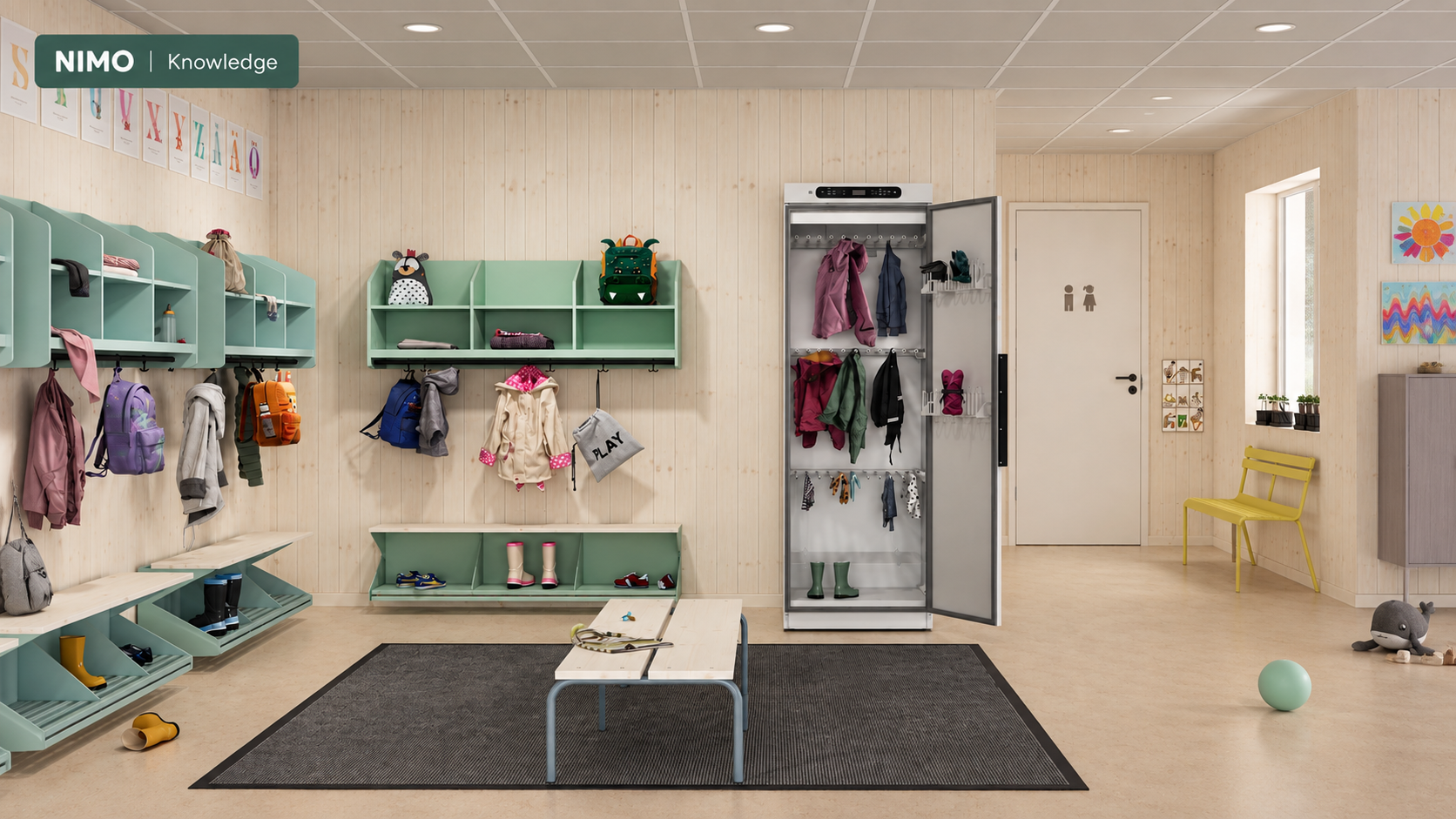
What happens during the drying process?
When wet textiles are placed in a drying cabinet, warm air circulates around them, gradually removing moisture. The efficiency of the process depends on several factors, including temperature, airflow and how long the textiles are exposed to the heat.
Heat also affects microorganisms. This led NIMO to ask whether a normal drying process could provide a hygienic benefit in addition to simply drying the textiles.
To investigate this, RISE (Research Institutes of Sweden) conducted the study “Dry heat inactivation of pathogens in dryer cabinet assessed by modelling” on behalf of NIMO in 2021.
The study was based on NIMO’s Mistral Drying Cabinet 60, then known as the Easy Dryer 1900, and examined, among other pathogens, SARS-CoV-2, the virus that causes COVID-19, and norovirus, a common cause of gastroenteritis.
What did the study show?
The study showed that the heat generated during normal use of the drying cabinet could inactivate both SARS-CoV-2 and norovirus.
Put simply, when a virus is inactivated, it is rendered harmless and can no longer cause infection. This means that the drying process can provide a hygienic benefit in addition to drying clothes and textiles.
Relevant in many environments
Preschools were an important starting point for the study, but the findings are relevant in many other environments.
Today, drying cabinets are used in schools, workplaces, emergency services, sports facilities and many other settings where wet clothes and textiles need to be dried and ready for use again.
This makes the drying cabinet an important part of everyday operations in many environments – with more benefits than you might initially expect.
Read the full RISE report:
Dry heat inactivation of pathogens in dryer cabinet assessed by modelling