
How Much Energy Does a Modern Drying Cabinet Really Use?
We run our washing machines and dishwashers without giving much thought to how much energy each cycle consumes. Yet when it comes to drying cabinets, the perception of high energy consumption persists.
Thanks to modern heat pump technology, the reality is quite different. A drying cabinet can actually use less than 1 kWh per drying cycle.
From Energy-Intensive to Energy-Efficient Drying
Drying cabinets have traditionally been associated with high energy consumption. This perception is largely based on older technology, where heated air absorbs moisture from textiles before being expelled through an exhaust ventilation system.
But advances in technology have changed the picture.
A modern heat pump drying cabinet, such as NIMO's Passad DC60, consumes just 0.92 kWh per drying cycle.
To put this figure into perspective, let's compare it with some of the household appliances we use regularly.
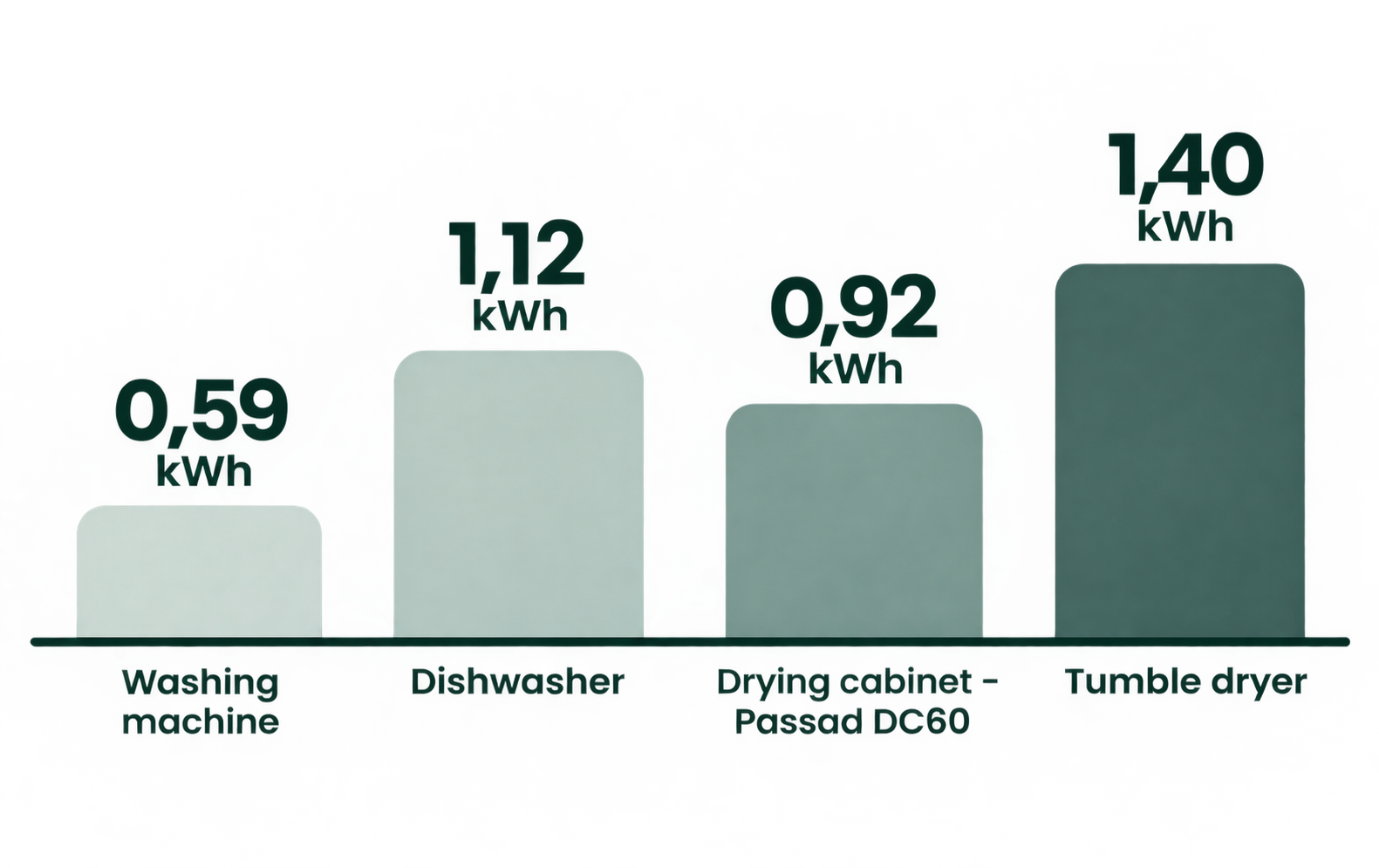
These figures show that a modern drying cabinet can have energy consumption per cycle comparable to that of other common household appliances.
Of course, these appliances serve different purposes, and actual energy consumption varies depending on factors such as programme selection and load size. Nevertheless, the comparison offers a useful perspective on just how far drying cabinet technology has progressed in terms of energy efficiency.
Sources: APPLiA Statistical Report 2022–2023 (washing machines and dishwashers), European Commission (tumble dryers), and NIMO product data (Passad DC60). The figures are based on different testing conditions and are intended as an illustrative comparison.
The Technology Behind Low Energy Consumption
The key difference lies in how heat is used.
In a conventional exhaust-air drying system, air is heated and then expelled along with the moisture. As a result, fresh air must continuously be heated throughout the drying process.
A heat pump drying cabinet works differently. Instead of releasing the heat, it recovers and reuses it within the drying process. Moisture is condensed and removed, while thermal energy continues to circulate within the system.
The Passad DC60 combines heat pump technology with intelligent sensor control that detects when textiles are dry and automatically ends the programme. It also offers a drying capacity of up to 11 kg.
This allows energy consumption to be adjusted to actual drying needs while maintaining a high drying capacity.
When Drying Is Part of Everyday Operations
In apartment buildings, schools and other facilities where large volumes of textiles need to be dried regularly, energy consumption becomes particularly important.
A drying cabinet is often used for many years. This means that the initial purchase price is only part of the equation. The energy consumed throughout the product's lifetime also plays an important role.
At three drying cycles per day, an energy consumption of 0.92 kWh per cycle amounts to approximately 1,007 kWh per year. For facilities operating multiple drying cabinets, energy efficiency therefore becomes an important factor in both operating costs and efforts to reduce overall energy consumption.
Time to Rethink Drying Cabinets
Technological advances have transformed what we can expect from a modern drying cabinet. Heat pump technology, intelligent controls and high drying capacity make it possible to combine effective drying performance with low energy consumption.
Learn more about the Passad DC60 Drying Cabinet.